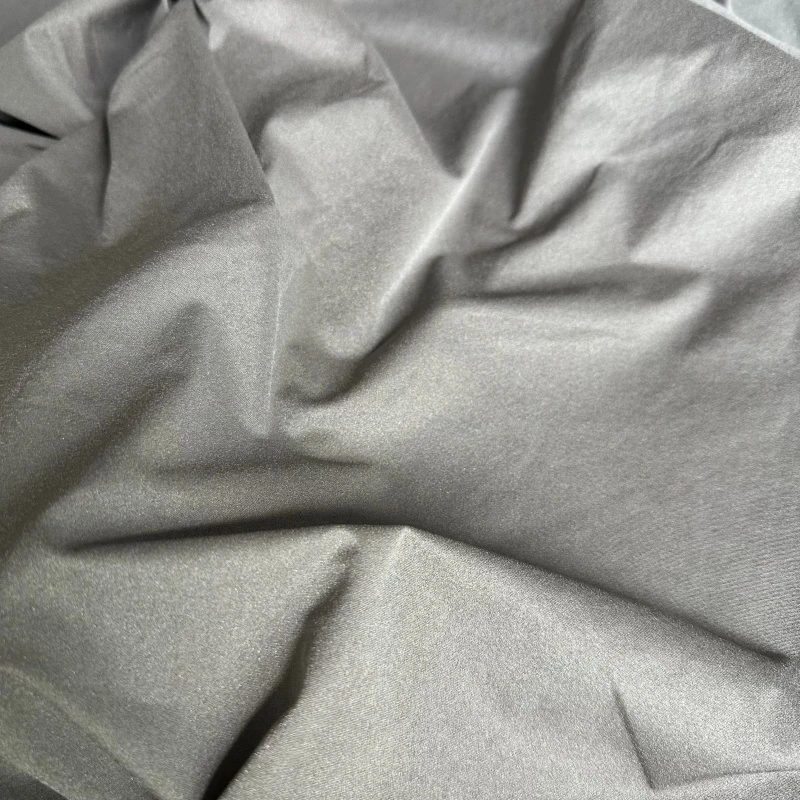
The secret of this fabric lies in its **manufacturing process**:
1. **Fiber modification**: **Nano-silver particles** or **silver ions** are incorporated into the textile fibers.
2. **Metallic coating**: A dense layer of **metallic silver** is coated onto the surface of ordinary yarn through chemical plating or physical deposition.
Silver is the most conductive metal in nature (resistivity of only 1.59 × 10⁻⁸ Ω·m). When silver fibers form a **closed circuit** with batteries or light bulbs, the silver fabric acts as a **flexible conductor**-electrons flow smoothly from the negative terminal of the battery along the "highway" of the silver fibers through the filament of the light bulb. The filament heats up and emits light due to the thermal effect of the current, then returns to the positive terminal, thus lighting the bulb.
Furthermore, silver's conductivity is highly sensitive to **contact pressure** and **tensile deformation**: pressing or stretching the fabric changes the contact resistance between the silver particles, causing the light bulb's brightness to flicker. This makes it suitable for use in the switch designs of **pressure sensors** or **smart clothing**. However, it should be noted that the silver fabric itself does not generate electricity, and the light bulb will not light up if it is removed from the battery.